
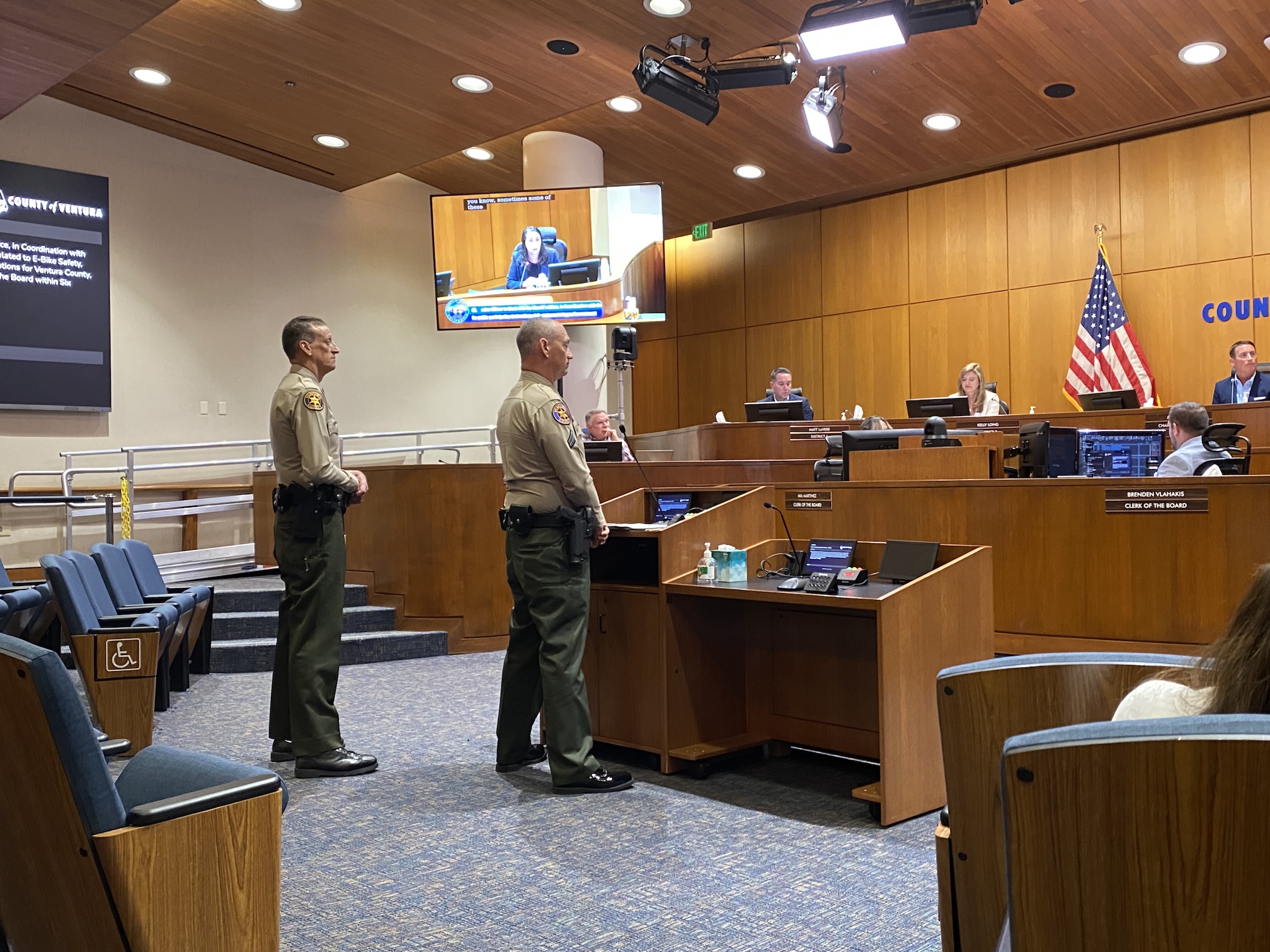
The Ventura County Board Of Supervisors unanimously passed the E-Bike Safety Measure at their April 28th meeting. Introduced by Supervisor Jeff Gorell in partnership with the Ventura County Sheriff’s Office, the measure aims to improve safety for e-bike riders (and the community) by evaluating best practices from across California. It focuses on education, enforcement, and policy options to address rising concerns like unsafe riding and collisions as e-bike use increases.
Testimony at the meeting highlighted what a complex challenge the e-bike issue has become—not just in Ventura County, but statewide. The Board is hoping that a collaboration between law enforcement, schools, families and community members will yield practical recommendations for improving safety. That won’t be easy, given several stubborn realities.
THIS IS NOT ONLY AN “E-BIKE” ISSUE
It would be quaint to blame poorly-categorized e-bikes operating in Ventura County as the problem. From law enforcement testimony, a bigger problem appears to be electric-powered off-road motorcycles being ridden on city streets, natural-surface trails, and in public spaces. Media outlets and many parents often label these machines as “e-bikes.” They are not.
These are motorized off-road vehicles. In California, they are restricted to designated off-highway vehicle (OHV) trails or private property. They are not legal to ride to school, on sidewalks, to the 7-Eleven, at a skatepark, or even in the county parks that allow e-bikes.
Lumping these vehicles into the E-Bike Safety Measure risks reinforcing the misconception that they are legitimate e-bikes. If someone rode a Honda CRF250 motocross bike around Camarillo, there would be a swift and substantial police response. The same standard should apply to these electric off-road motorcycles. Plenty of rules already exist—we shouldn’t create a gray area by misclassifying them.
E-BIKE CLASS DESIGNATIONS ARE THE ROOT PROBLEM
The current e-bike classifications (Class 1, 2, and 3) were originally drafted by a trade organization with three apparent goals: open previously non-motorized trails and paths to motorized vehicles, make enforcement more difficult, and sell more e-bikes. State lawmakers adopted these industry-drafted guidelines in a rush, likely without fully grasping how much they favored manufacturers over public safety.
Any recommendations from the E-Bike Safety Measure will be constrained because California has already locked in these flawed class designations. (You can read my earlier research on e-bike designations by clicking here.)
THE ONE-BIKE SOLUTION
Here’s how I would fix the mess: California should allow only one type of e-bike access to places once reserved for bicycle riders and pedestrians, like bike paths and trails. It would require the rider to pedal before any motor assistance engages, and that assistance would cut off at 15 mph (not 20 mph). Today’s Class 2 and Class 3 e-bikes would be reclassified as mopeds (because they are) and regulated more like motorcycles than bicycles. That means no riding on bike paths or natural-surface hiking trails.
Of course, this will never happen. The genie is out of the bottle. The e-bike industry congratulated itself for fast-tracking its three-class system and must now live with the serious problems it helped create.
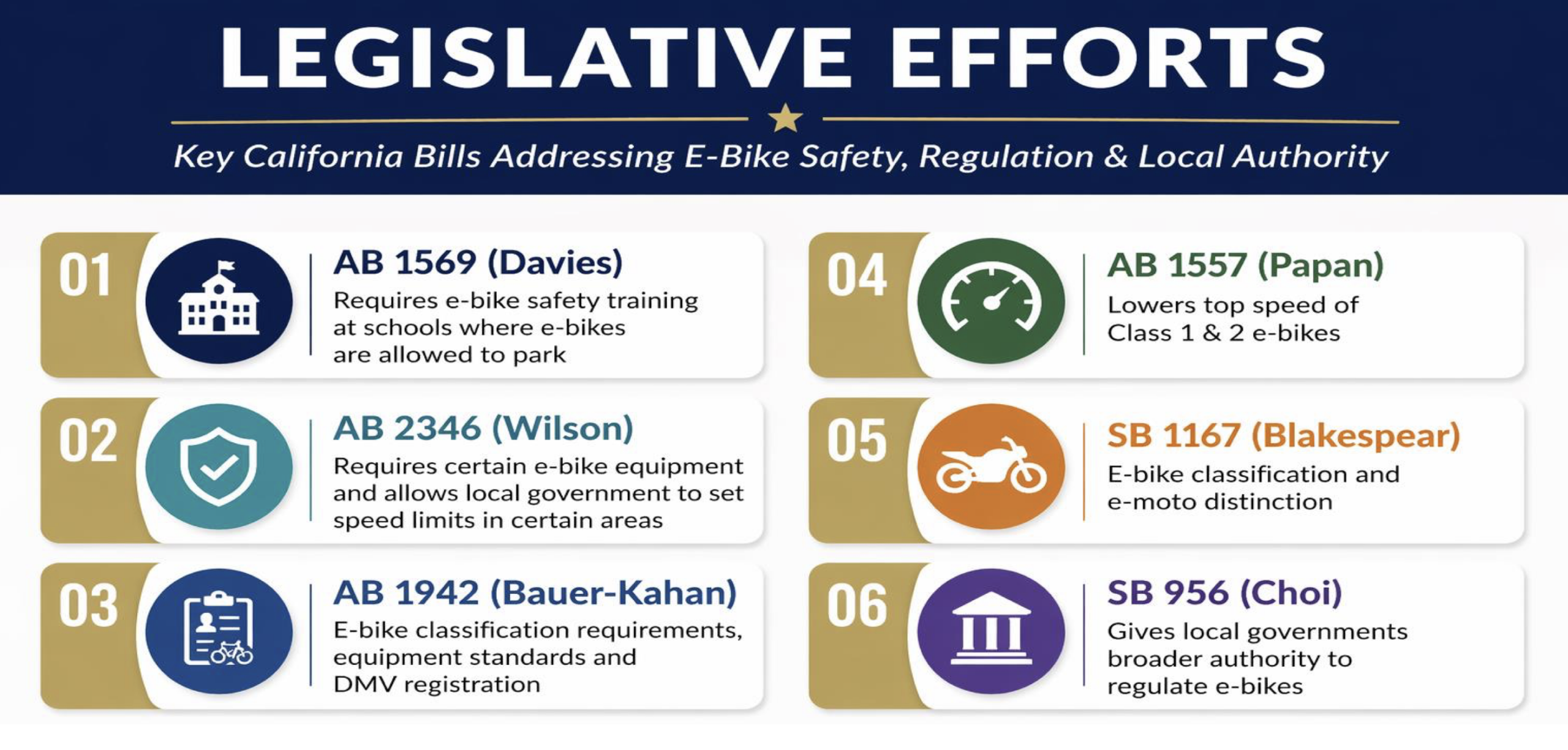
THE E-BIKE SAFETY MEASURE IS NEEDED
Kudos to Supervisor Jeff Gorell and the rest of the Ventura County Board of Supervisors for advancing the E-Bike Safety Measure. It faces an uphill battle, but if it saves even one life, the effort will be worthwhile.
The meeting made it clear that California needs a united effort to increase e-bike safety. Leaving it up to individual communities, even if they share and learn from each other, will not result in a cohesive action plan that can be easily understood and implemented quickly. And sadly, increased safety is something needed today.
About the author: Jim “Jimmy Mac” McIlvain was Editor of Mountain Bike Action Magazine, Road Bike Action Magazine and Motocross Journal. He was a contributing editor of Electric Bike Action Magazine and Motocross Action Magazine. He was voted into the Mountain Bike Hall of Fame. He has been used as a resource by land management agencies in developing e-bike and mountain bike policy. He welcomes feedback or questions from land management agencies, law enforcement, retailers and riders. The Jimmy Mac On Two Wheels website is self-funded.